Crispy Fish and Chips
Two oil temperatures, one batter that must stay cold, and a pot of hot fat that deserves more respect than most recipes give it.
Total: 1 hr 20 minYield: 4 servingsMethod: Deep Frying
In this recipe
Before the oil goes on the heat
Eight cups of oil at 375°F is the most hazardous thing in this recipe, and it is worth setting up properly rather than improvising. A heavy, deep pot filled no more than halfway leaves room for the surge that happens the moment food goes in. A pot filled two-thirds will overflow.
A clip-on thermometer is not optional equipment here. Guessing the temperature means either frying at 300°F, where the batter absorbs oil and turns greasy, or at 425°F, where it browns before the fish inside is cooked.
Keep a lid that fits the pot within arm's reach. If oil ever catches, the lid smothers it; water thrown onto burning oil turns instantly to steam and throws flaming fat across the room. Dry everything that goes into the pot for the same reason — wet potatoes are the usual cause of a violent boil-over.
Lower food into the oil away from you, never drop it, and never leave the pot unattended while the burner is on.
Why the chips are fried twice
A single fry gives either a raw center or a burnt outside. Two temperatures separate the two jobs.
- The cold soakThirty minutes in cold water pulls surface starch off the cut potatoes. Left on, that starch browns long before the inside is cooked and makes chips that stick to each other.
- First fry, 325°FFive to six minutes. The potato cooks through and goes soft, and it should come out pale — color at this stage means the oil is too hot.
- The restOn a rack while the oil comes up to 375°F and the fish is fried. The surface dries out, which is what lets it crisp properly on the second pass.
- Second fry, 375°FTwo to three minutes, purely for the crust. The inside is already cooked, so this is short and entirely about color and crunch.
What makes the batter crisp
Four dry ingredients and one cold liquid, each with a specific role.
- All-purpose flour
- The structure. On its own it makes a batter that is sturdy but heavy, which is why it is not the only starch in the bowl.
- Cornstarch
- Has no gluten, so it lightens the coating and makes it noticeably crisper. Half a cup to a cup of flour is the balance this recipe uses.
- Baking powder
- Produces gas in the hot oil, opening the batter into a lighter, more porous shell rather than a solid crust.
- Cold beer or soda water
- Carbonation adds lift, and the cold slows gluten development. A batter mixed with room-temperature liquid and left standing goes slack and tough.
- The flour dusting
- A separate, thin coat on the fish itself. Batter will not cling to a wet fillet; it needs a dry, floury surface to grip.
Troubleshooting
| Problem | Cause | Fix |
|---|---|---|
| The batter slid off in the oil | The fish was wet, or the flour dusting was skipped. | Pat the fillets completely dry and dust them with flour before they go into the batter. |
| The coating is greasy | The oil dropped below temperature, usually from frying too much at once. | Two pieces at a time, and let the oil recover to 375°F between batches. |
| The batter browned before the fish cooked | The oil was too hot. | Hold 375°F on a thermometer. If pieces are very thick, cut them smaller rather than lowering the heat mid-fry. |
| The chips are soggy | Only fried once, or drained on paper towel. | Both fries are necessary, and a wire rack keeps the underside crisp where paper traps steam. |
| The batter is tough | Overmixed, or made in advance. | Whisk until just combined, leave the lumps, and use it straight away while it is cold. |
Storage and reheating
This is a dish to eat immediately. Nothing you do afterwards recovers the crust that comes off the fryer, and it is worth planning the meal around that rather than around leftovers.
If there are any, refrigerate up to 2 days and reheat to 165°F (74°C), the USDA safe temperature for leftovers. A hot oven or air fryer at 400°F for 8 to 10 minutes gets closest; a microwave turns the batter to a soft skin.
Cooled frying oil can be strained through a fine sieve and reused two or three times for fish. Store it sealed and away from light, and discard it once it darkens, smells strongly, or begins to smoke below its usual temperature.
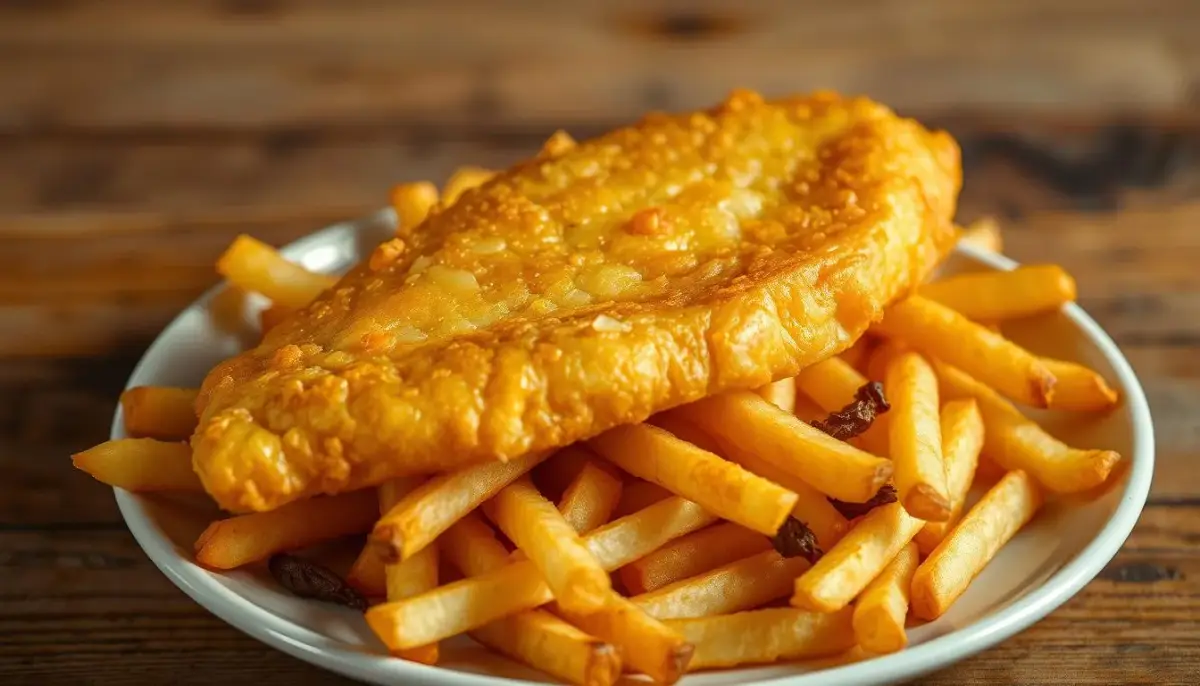
Crispy Fish and Chips
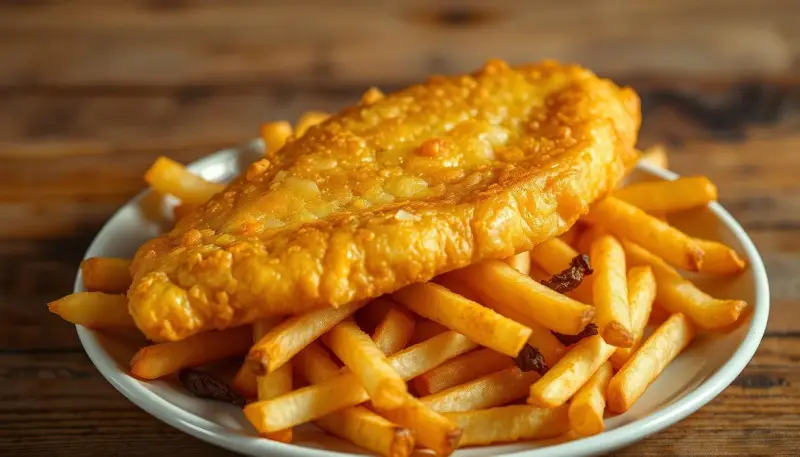
Cod in a cold-beer batter cut with cornstarch and baking powder, fried at 375°F, alongside chips given the traditional two-stage fry — soft first at a lower temperature, crisp second at a higher one.
- Seafood
- Main Dish
- Deep Frying
The frying oil is a fixed quantity set by the pot, not by the number of servings, and the two oil temperatures do not change with batch size. Scaling these numbers would suggest multiplying the oil and would give a misleading total time, since larger amounts simply mean more batches through the same pot.
Cook’s checkpoint
- Frying oil
- 350°F / 175°C
- Chicken, thickest part
- 165°F / 74°C
Use a food thermometer. Color and time alone don’t confirm poultry is done.
Ingredients
For the chips
For the fish
For the batter
For frying
Instructions
Notes
- Haddock, pollock and hake all work in place of cod. Any firm white fish of similar thickness behaves the same in this batter.
- The beer contributes carbonation and a little flavor; cold soda water gives an equally light result without either. What matters in both cases is that the liquid is genuinely cold.
Cooking Mode
Questions
- Which fish is best?
- Cod is traditional and its large flakes suit the batter. Haddock, pollock and hake all work. What matters is a firm white fish in pieces of roughly even thickness so they finish together.
- Can the fish be baked instead?
- A wet beer batter does not bake — it runs off. For an oven version, use a breadcrumb coating on floured, egg-washed fish at 425°F. It is a good dish, but it is not this one.
- Does the beer have to be beer?
- No. Cold soda water gives the same lift from carbonation without any alcohol. Beer adds a faint malt flavor and nothing else.
- How long does the fish take?
- Five to seven minutes at 375°F for pieces around an inch thick, turning once. Confirm 145°F at the thickest point rather than judging by color alone, since batter browns on its own schedule.