Garlicky Creamy Chicken
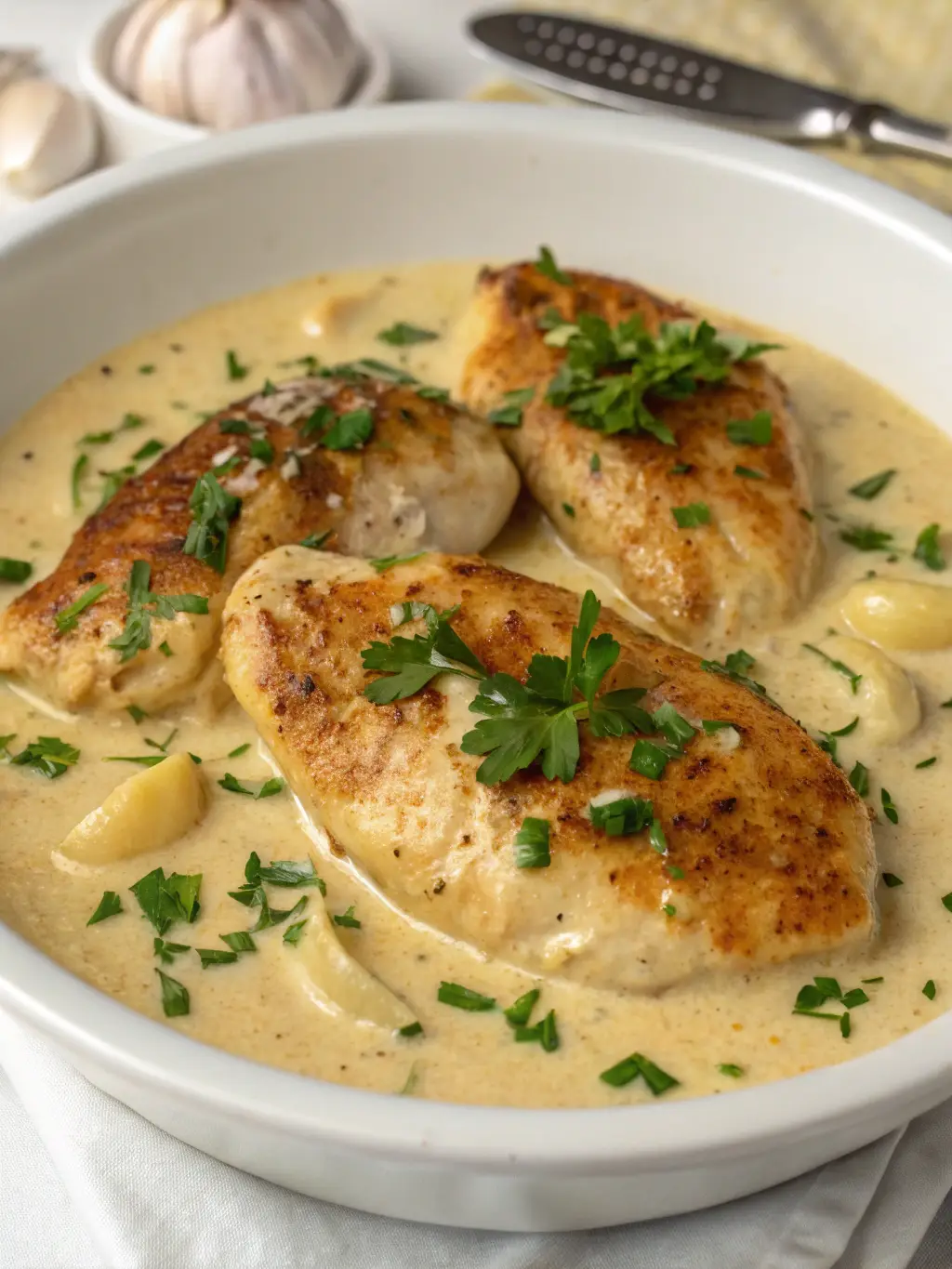
Eighteen cloves of garlic, prepared three ways, because how it is cut matters as much as how much goes in.
Total: 45 minYield: 4 servingsMethod: Pan Searing
In this recipe
Why the same ingredient appears three times
Garlic's flavor is created by cutting it. The finer the cut, the more of it forms — which is why quantity alone tells you almost nothing.
- Twelve whole cloves, slow-cooked
- An intact clove releases very little of the compound that makes garlic pungent. Cooked gently for ten minutes they turn sweet, nutty and spreadable — this is the bulk of the dish and it is mild.
- Four sliced cloves, browned briefly
- Cutting starts the reaction, so these are noticeably sharper. A minute in the pan takes the raw edge off while keeping them distinct from the whole ones.
- Two grated cloves, raw and last
- Grating ruptures the most cells and produces the most pungency. Added off the heat they stay bright and are what makes the finished sauce smell like garlic rather than like cream.
- Parmesan
- Salt and savory depth. It goes in off the heat with the raw garlic — melted into a simmering sauce it turns grainy.
- Dijon
- A teaspoon, undetectable as mustard. It emulsifies the sauce and keeps the cream and the pan fat from separating.
The order the pan runs in
One skillet throughout, with the heat coming down at each stage.
- Chicken, medium-highFloured cutlets, four to five minutes a side. The flour left in the pan will thicken the sauce later.
- Whole cloves, medium-lowThe longest stage and the one that cannot be rushed. High heat here scorches them bitter instead of sweetening them.
- Sliced cloves, one minuteJust enough to color. They go in late precisely because they are meant to stay sharper.
- Wine, then broth, then creamEach reduces before the next arrives. Adding them together gives a thin sauce that never concentrates.
- Off the heat: parmesan and raw garlicBoth are damaged by direct heat — the cheese goes grainy, the raw garlic loses its point.
Troubleshooting
| Problem | Cause | Fix |
|---|---|---|
| The garlic is bitter | The whole cloves were cooked over too high a heat. | Medium-low for the full 8 to 10 minutes. Scorched garlic cannot be rescued and will flavor the whole sauce. |
| The sauce split | The cream boiled, or the parmesan went in over heat. | Gentle simmer only, and cheese off the burner. The Dijon helps but will not save a boiled sauce. |
| It does not taste of garlic | The raw grated cloves were cooked with everything else. | They go in at the very end, off the heat. That is where the aroma comes from. |
| The chicken is dry | Cooked past 165°F. | Halved cutlets cook fast. Check at four minutes a side and pull at temperature. |
| The sauce is thin | The stages were combined rather than reduced in sequence. | Wine by half, then broth for three minutes, then cream. Each reduction concentrates the one before. |
Storage and reheating
Refrigerate up to 3 days with the chicken under the sauce. The garlic mellows further overnight, so the dish is noticeably less pungent on the second day.
Reheat to 165°F (74°C), the USDA safe temperature for leftovers, covered over low heat. A cream sauce reheated fast separates; if it looks broken, take it off and whisk in a splash of cold cream.
It does not freeze. Cream and parmesan both separate on thawing, and grated raw garlic turns harsh and slightly metallic after freezing.
Garlicky Creamy Chicken
Chicken cutlets seared and finished in a cream sauce built on garlic used three different ways — whole cloves softened, sliced cloves browned, and raw grated garlic stirred in off the heat.
- Chicken
- Main Dish
- Pan Searing
Cook’s checkpoint
- Frying oil
- 350°F / 175°C
- Chicken, thickest part
- 165°F / 74°C
Use a food thermometer. Color and time alone don’t confirm poultry is done.
Ingredients
For the chicken
For the garlic base
For the sauce
Instructions
Notes
- Eighteen cloves sounds extreme and is not. Twelve of them are cooked until sweet and mild, which is closer in effect to a soft onion than to raw garlic.
- The whole cloves are meant to be eaten. Crushed lightly against the plate they spread like a paste, and they are the best part of the dish.
Cooking Mode
Questions
- Is eighteen cloves too much garlic?
- It reads that way on paper and does not taste that way. Two thirds of it is cooked whole until sweet and mild — closer to soft shallot than to raw garlic. Only two cloves go in raw.
- Can pre-minced jarred garlic be used?
- Not for this. The whole-clove stage depends on intact cloves, and jarred garlic is already cut, acidified and uniformly sharp. It would collapse the three-layer effect the recipe is built on.
- Can this be made without wine?
- Yes. Half a cup of chicken broth with a teaspoon of white wine vinegar deglazes and supplies the acidity the cream needs.
- What should it be served with?
- Something to take the sauce — mashed potato, egg noodles, rice or bread. There is a generous amount of it and it is the point of the dish.