Swiss Steak
Nothing Swiss about it — the name comes from swissing, a mechanical way of flattening tough meat.
Total: 2 hr 25 minYield: 6 servingsMethod: Braising
In this recipe
Why the meat gets hit before it gets cooked
Swissing is a textile term for rolling cloth between rollers to flatten it, and it was borrowed for the machine that does the same to tough cuts of meat. The dish is named for the process, not the country.
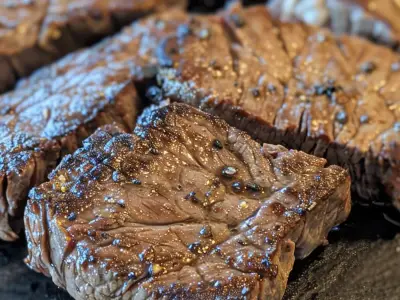
Round steak comes from the rear leg. It is very lean and its muscle fibers are long and tightly bundled, which is why it is cheap and why it eats like shoe leather if you simply fry it. Pounding physically shortens and separates those bundles before any heat is involved.
It also evens the thickness, which matters over a two-hour braise: a piece twice as thick as its neighbor will still be tight when the thin one has gone stringy. Half an inch across every portion is the target.
Braising then does the rest. Two hours of gentle wet heat converts the connective tissue that survives the mallet, and the two techniques together are what turn a hard cut into something a fork goes through.
Flour, fond, gravy
The flour does three separate jobs, and each one happens at a different stage.
- On the meatA dry coating gives the surface something to brown. Wet beef steams; floured beef takes color in three minutes a side.
- In the panSome flour inevitably sticks and toasts. That is fond with a head start, and it dissolves into the onions when they release their moisture.
- In the gravyThe rest thickens the braising liquid slowly across two hours. This is why the finished gravy needs no slurry — it has been thickening the whole time.
- 325°F, covered, in the ovenOven heat surrounds the pot evenly where a burner heats only the base. Two hours, and the test is a fork rather than a clock.
Troubleshooting
| Problem | Cause | Fix |
|---|---|---|
| The steak is tough after two hours | It was not pounded, or the pieces were uneven. | Pound to a consistent half inch. On round steak this is not optional. |
| The gravy is thin | Too much liquid, or the flour was shaken off completely. | Press the flour in and keep the liquid just level with the meat. Simmer uncovered 10 minutes at the end if needed. |
| It tastes sharp | Canned tomato acidity over a long braise. | The teaspoon of sugar is there for this; a second is reasonable with a very acidic brand. |
| The meat is dry despite being tender | The braise boiled rather than simmered. | 325°F in a covered pot holds a bare simmer. A hard boil squeezes moisture out faster than collagen converts. |
| The bottom scorched | The fond was not lifted before the liquid went in. | Let the onions do that work — their moisture releases the toasted flour from the base. |
Storage and reheating
Refrigerate up to 4 days with the steaks under the gravy. This is a dish that genuinely improves overnight, as the gravy thickens further and the tomato loses its edge.
Reheat to 165°F (74°C), the USDA safe temperature for leftovers, covered over low heat or at 325°F for 20 minutes. Add a splash of broth — the flour keeps thickening in the refrigerator.
It freezes well for 3 months, since there is no dairy in it. Freeze the steaks in the gravy so the surfaces stay protected.
Swiss Steak
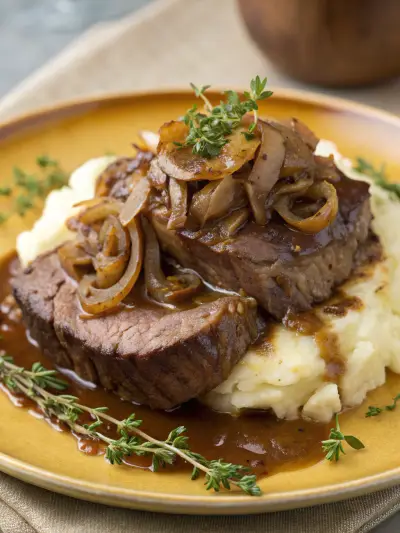
Round steak pounded thin, dredged in seasoned flour, browned and braised low in a tomato and onion gravy until a fork goes through it. The pounding is a mechanical step, not a flavor one.
- Beef
- Main Dish
- Braising
Cook’s checkpoint
- Frying oil
- 350°F / 175°C
- Chicken, thickest part
- 165°F / 74°C
Use a food thermometer. Color and time alone don’t confirm poultry is done.
Ingredients
For the steak
For the gravy
To finish
Instructions
Notes
- Round is the traditional cut and the one this method exists for. Chuck also works and needs no pounding, but it is fattier and gives a different, richer result.
- The dredging flour thickens the gravy on its own over two hours. No slurry is needed unless you have added extra liquid.
Cooking Mode
Questions
- What cut is Swiss steak made from?
- Traditionally round — top round or bottom round. It is lean, tough and inexpensive, which is exactly the problem the pounding and braising solve. Chuck is a reasonable substitute and needs no pounding.
- Can this be done in a slow cooker?
- Yes, after the pounding, dredging and browning, which still need a skillet. LOW for 7 to 8 hours. The gravy will be thinner because nothing evaporates under the lid.
- Why is it called Swiss steak?
- From swissing, a process of flattening material between rollers. It refers to the mechanical tenderizing, not to Switzerland.
- What should it be served with?
- Something to take the gravy: mashed potato, egg noodles, rice or bread. The gravy is half the dish and wants a vehicle.